What Is Infinite Banking, Really? A Plain-English Look at the Strategy Wealthy Families Have Used for 100 Years
How a specific kind of financial structure lets your cash value compound at full value even while a loan is out against it, and the one check that tells the real thing from an IUL trap.


You've heard the phrase tossed around, Infinite Banking, Be Your Own Bank. Maybe a friend who owns a business mentioned it. Maybe a podcast host swore by it.
And your gut reaction was the honest one: that sounds too good to be true. Money that keeps growing while you spend it? A loan with no bank approval? It has the shape of every gimmick you've learned to ignore.
So you filed it away. But the phrase keeps coming back, because part of you wants to know if it's real.
So why does the bank always win?

Think about how a normal loan works.
You save money. The bank holds it. Then when you need to buy something big, you borrow, and pay the bank interest to use money that was yours to begin with.
Every dollar of interest leaves your pocket and never comes back. Do that across a car, a home, a business purchase, and the numbers get uncomfortable fast.
The frustrating part isn't that banks charge interest. It's that you're funding their growth instead of your own, and most people never question the setup because it's the only one they've ever been shown.
What if you could be your own bank the right way?

Wealthy families have used this for over a century.
Instead of parking savings in a bank, they build it inside a specific kind of whole life insurance policy, one that grows steadily and pays out a share of the company's profits each year.
When they need cash, they don't withdraw it. They borrow against it. And this is the part that surprises everyone: with the right policy, your full balance keeps growing as if you never touched it, even while the loan is out.
That's the core mechanism. Call it the keep-growing rule. Your cash value and your loan access operate independently, funding your purchase and still compounding for you.
However, there is a critical distinction most people miss. This only works with one exact type of policy. Get sold the wrong one, and the magic disappears.
How do you know if a policy is the real thing?

This is where most people encounter problems.
A huge share of what's marketed online as infinite banking is built on the wrong product, often an IUL, a policy tied to the stock market that can quietly stall out and drain the growth you were promised.
The real thing is narrower than that. It only works with a custom-designed, high-cash-value whole life policy from a dividend-paying mutual company, structured so your money stays liquid early and keeps compounding at full value while a loan is out.
That's exactly what an Infinite Banking Strategy Consultation is built to sort out. With 20+ years designing these policies, the focus is on structure, not sales, no commission chase, no hidden fees.
You start with a free 5-point checklist that tells you whether a policy is the genuine keep-growing kind, or an IUL trap dressed up to look like one. No obligation, just clarity.
What does controlling your own capital actually get you?
Being your own bank isn't a slogan, it's a set of everyday advantages that stack up over years. Here's what changes once your money compounds inside a properly structured policy instead of sitting in someone else's vault.
What are you getting?
The consultation isn't a sales pitch dressed as advice. It comes with tools designed to help a curious newcomer judge the strategy for themselves before ever committing to anything.
Why do people trust this over a bank?
 1
1
The strategy is 100 years old, battle-tested by wealthy families
Infinite Banking isn't new speculation, it emerged in the 1920s and has been quietly used by high-net-worth families and business owners for a century. The IRS has never challenged the structure; mutual insurance companies have refined it across generations. This isn't a get-rich-quick scheme; it's a discipline-based wealth engineering approach proven across economic cycles.
 2
2
Most IBC policies sold online are fundamentally broken structures
85% of what's marketed as infinite banking online is either IUL (indexed universal life) or poorly designed whole life, both fail the core requirement: maximum early cash value and dividend-paying structure. An IUL looks good on paper but charges hidden fees and caps growth. A custom-designed, high-cash-value dividend-paying whole life from a mutual company is the only structure that actually works. One checklist can identify the trap.
 3
3
Your money compounds uninterrupted while you borrow against it
The defining feature of infinite banking is that cash value keeps growing at its full rate even while you have an outstanding policy loan. You borrow $50,000 to invest in real estate or business equipment, your policy's cash value continues compounding as if the loan doesn't exist. You're not choosing between growth and access; you get both simultaneously. That's structurally impossible in a traditional bank account.
 4
4
Properly structured IBC beats traditional bank financing by $20,411 over five years
An interactive calculator shows the real math: a properly designed policy generates a $20,411 wealth advantage over five years compared to traditional bank loans. That advantage comes from recapturing interest, avoiding credit checks, controlling repayment terms, and keeping dividends flowing on your full cash value. The comparison isn't marketing hype, it's built on actual policy rates (5% average) versus commercial bank rates (7.5% average) and documented dividend history from mutual companies.
 5
5
You avoid the approval gatekeeping that locks out real investors
Banks say no. They run credit checks, demand W-2s, slow-walk approvals, and deny deals that don't fit their boxes. With a properly structured IBC policy, you borrow against your own cash value, no credit score threshold, no bank approval, no waiting. For business owners facing seasonal income swings or investors moving fast on opportunities, this isn't a nice-to-have; it's the difference between capturing a deal and watching it close. Your policy loan is yours to access when you need it.
How does it stack up?
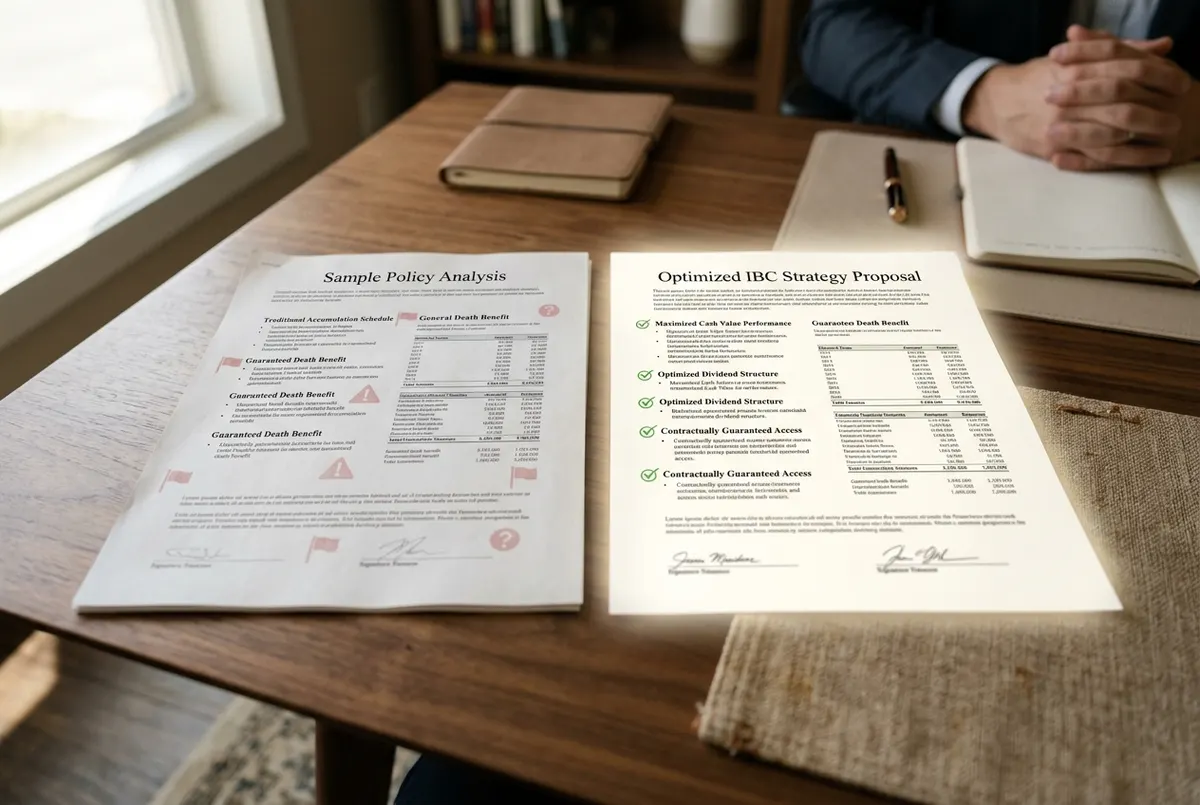
The clearest way to see the difference is to put the two side by side, the same purchase, financed two ways. One keeps the interest flowing out to a bank; the other keeps it working for you.
- Index Universal Life (IUL) marketed as IBC
- Agent commissions exceed 100% first-year premium
- Cash value inaccessible first 2-3 years
- Loan stops dividend accrual on borrowed amount
- No dividend guarantees or mutual ownership
- Hidden fees reduce actual cash accumulation
- Custom whole life with mutual companies only
- Maximum PUA rider for 85%+ early liquidity
- Cash accessible within first policy year
- Non-Direct Recognition maintains full dividend on borrowed funds
- Guaranteed compounding plus tax-free dividends annually
- Transparent cost structure verified before design
Get Started Today

Still have questions?
Most people arrive with the same three doubts: is this legitimate, how do I avoid getting sold the wrong policy, and how do I know the advisor isn't just chasing a commission? Here are the honest answers.
See where you stand in 60 seconds